One of the Most Repeated Phrases in the English Language Is Just Straightforwardly Wrong
One of the Most Repeated Phrases in the English Language Is Just Straightforwardly Wrong
Some myths are complicated. They have a kernel of truth, or they require careful unpacking to understand why people believe them. They're the kind of thing where the real story is nuanced and the myth is at least understandable.
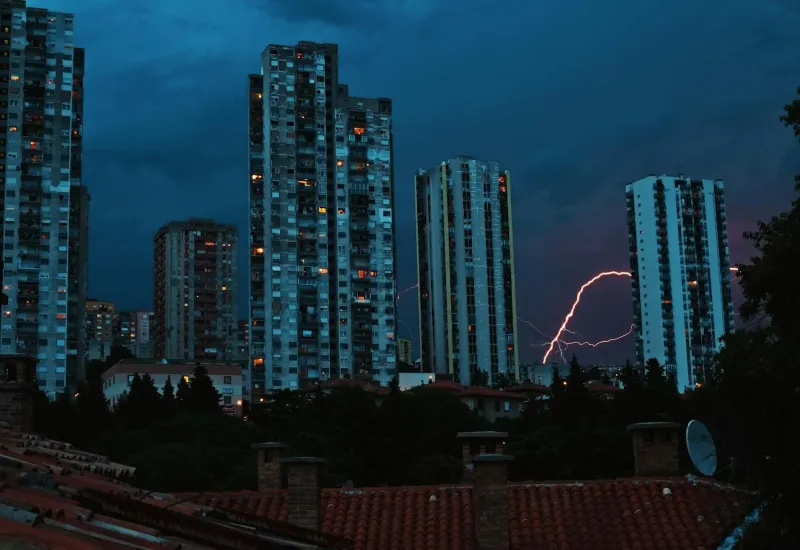
And then there's "lightning never strikes the same place twice," which is just wrong. Not mostly wrong, not wrong in certain contexts — wrong in the most basic, observable, measurable way a factual claim can be wrong.
The Empire State Building is struck by lightning approximately 20 to 25 times per year. Every year. The same building. Repeatedly.
So where did this saying come from, why does everyone keep repeating it, and — more interestingly — why do people use it as if it were a reliable guide to how probability actually works?
What Lightning Actually Does
To understand why the saying is false, it helps to understand what lightning is actually doing when it strikes.
Lightning is an electrical discharge — a massive flow of electrons looking for the fastest path between a charged cloud and the ground. It doesn't choose randomly. It follows the path of least resistance, which in practical terms means it's strongly attracted to tall objects, conductive materials, and anything that reduces the distance between cloud and earth. That's why lightning rods work: they give the electrical charge a predictable, controlled path to follow, protecting everything around them.
A tall building in an open area is essentially a permanent invitation. Every storm that rolls over Manhattan puts the Empire State Building in the same position: the tallest thing around, fully conductive, perfectly positioned to complete a circuit. The storm doesn't remember that it struck last Tuesday. The physics don't care. The building gets hit again.
The same principle applies to tall trees (which is why sheltering under one in a storm is genuinely dangerous), metal towers, radio antennas, and open hilltops. These places get struck repeatedly not in spite of having been struck before, but precisely because the conditions that made them attractive targets haven't changed.
A Brief, Interesting History of the Saying
The phrase has been traced back at least to the 19th century, and its original use was probably more poetic than literal. In an era before widespread scientific education, lightning felt genuinely random and mysterious — an act of God or nature that seemed to operate outside of human understanding. Saying it wouldn't strike the same place twice was a way of expressing the idea that catastrophic misfortune was unlikely to repeat itself. It was folk comfort, essentially.
There's also a military theory about the phrase's origins. Some historians believe it emerged from battlefield observations — specifically, that artillery shells rarely landed in exactly the same crater twice, making old shell holes relatively safer positions during a bombardment. Whether or not that's the actual source, the logic is similar: a one-time event feels unlikely to repeat in the exact same spot.
As a metaphor for reassurance, it makes a certain emotional sense. As a statement of physical fact, it never held up.
The Real Problem: When People Apply It to Risk
Here's where things get genuinely interesting, and a little concerning.
"Lightning never strikes the same place twice" has migrated from folk saying to something people treat as an actual model for how probability works — and that migration has real consequences.
You hear versions of this logic all the time. Someone whose house was robbed once figures it's unlikely to happen again — same neighborhood, same house, why would lightning strike twice? Someone who was in a car accident reassures themselves that the odds of it happening again must be lower now. A business that went through a rough patch assumes the worst is behind them simply because they already went through it once.
This is a cognitive bias sometimes called the "gambler's fallacy" — the mistaken belief that past random events influence the probability of future ones. A roulette wheel that has landed on red ten times in a row is not "due" for black. A location that has been struck by lightning is not protected by having been struck before. Each event operates on its own conditions, independent of history.
The lightning saying gives this fallacy a folksy, quotable form that makes it feel like wisdom rather than error.
Why Catchy Sayings Outlast Accurate Ones
Part of what makes this particular myth so durable is that it sounds wise. It has the rhythm of a proverb. It's short, memorable, and easy to deploy in conversation. Nobody stops to check whether it's true because it doesn't feel like the kind of thing that needs checking — it feels like the kind of thing that has always been known.
This is a pattern worth noticing, because it shows up everywhere. Phrases that feel like wisdom get repeated long after the underlying claim has been disproven or was never accurate to begin with. The breakfast myth works the same way. So does "we only use ten percent of our brains" (we don't), and "you lose most of your body heat through your head" (only if your head is the only part of you that's exposed).
Catchy beats accurate, in the short run. The problem is that the short run can last a very long time.
The Actual Takeaway
Lightning absolutely strikes the same place twice. It strikes the same places dozens of times, every single year, because the physics that make a location a good target don't reset between storms.
The saying was never meant to be taken literally, but at some point it started being applied as though it were a reliable rule of probability — and that's where it quietly causes harm. Understanding that past events don't protect you from future ones isn't just a physics lesson. It's a genuinely useful way to think about risk.
Next time someone offers you the lightning line as comfort, you can smile and let them have it. Just don't make any actual decisions based on it.