The Brain Myth That Spawned a Billion-Dollar Personality Industry

The Meeting That Launched a Thousand Workshops
Somewhere in corporate America right now, an HR manager is explaining to new employees that "left-brain thinkers" excel at logic and analysis, while "right-brain people" are naturally creative and intuitive. Personality assessments promise to reveal your "dominant hemisphere." Team-building exercises sort colleagues into analytical versus artistic categories.
This billion-dollar industry of brain-based personality typing has one small problem: it's completely unsupported by neuroscience.
The Nobel Prize That Started It All
The left-brain/right-brain story begins with legitimate scientific breakthrough. In the 1960s, neurobiologist Roger Sperry studied patients who had undergone split-brain surgery—a radical treatment for severe epilepsy that severed the corpus callosum, the bridge connecting the brain's two hemispheres.
 Photo: Roger Sperry, via rogersperry.org
Sperry's ingenious experiments revealed that the severed hemispheres could function independently. The left hemisphere typically processed language and logical sequences, while the right hemisphere handled spatial relationships and pattern recognition. This groundbreaking work earned Sperry the 1981 Nobel Prize in Physiology or Medicine.
But here's the crucial detail that got lost in translation: Sperry studied people whose brains had been surgically divided. His findings applied to a tiny population of patients with severed neural connections, not to the general public with intact brains.
How Science Became Self-Help
The transformation from medical research to pop psychology happened gradually, then suddenly. Science journalists simplified Sperry's complex findings for general audiences. Self-help authors saw opportunity in the idea that personality could be explained by brain anatomy.
By the 1970s, books like "Drawing on the Right Side of the Brain" by Betty Edwards had popularized the notion that people could access their "creative right brain" through specific techniques. The concept was irresistible: it offered a scientific-sounding explanation for why some people seemed naturally artistic while others excelled at mathematics.
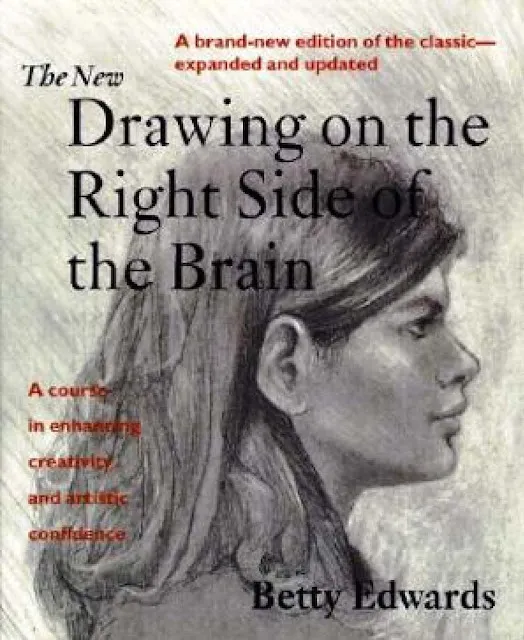 Photo: Betty Edwards, via 3.bp.blogspot.com
Corporate trainers embraced the framework enthusiastically. The left-brain/right-brain model provided a simple way to categorize employees and explain workplace dynamics. It felt more sophisticated than previous personality typing systems because it was supposedly based on brain science.
What Your Brain Actually Does
Modern neuroscience has thoroughly debunked the idea that people use one brain hemisphere more than the other. Brain imaging technology reveals that virtually all cognitive tasks activate networks spanning both hemispheres.
When you solve a math problem—supposedly a "left-brain" activity—your right hemisphere contributes spatial reasoning and helps you visualize the problem. When you create art—allegedly "right-brain" work—your left hemisphere organizes sequences, plans movements, and processes any verbal instructions you give yourself.
A 2013 study at the University of Utah analyzed brain scans from over 1,000 people and found no evidence that individuals had stronger neural networks on one side. The researchers concluded that the brain operates as an integrated system, with both hemispheres contributing to virtually all mental activities.
 Photo: University of Utah, via images.forbes.com
The Creativity Myth That Won't Die
The most persistent aspect of the left-brain/right-brain myth involves creativity. Countless articles, workshops, and books promise to "unlock your right-brain creativity" or help "logical left-brain types" become more innovative.
But creativity research tells a different story. Studies of highly creative individuals—from jazz musicians to Nobel Prize-winning scientists—show that innovation requires integration of analytical and intuitive thinking, not dominance of one hemisphere over the other.
Neuroscientist Arne Dietrich found that creative insights involve the default mode network, a system spanning both hemispheres that becomes active during rest and reflection. The most creative people aren't those who favor one side of their brain—they're those who effectively coordinate both sides.
Why We Love Simple Categories
The left-brain/right-brain myth persists because it satisfies our desire for simple explanations of complex phenomena. Personality is messy and multifaceted, but the hemisphere model offers clean categories that feel scientific.
The framework also provides a flattering excuse for limitations. Struggling with math? You're just a "right-brain person." Can't draw? Your "left-brain dominance" explains everything. These explanations feel better than admitting that skills require practice and that abilities can be developed.
Corporate environments particularly embrace the myth because it offers a seemingly objective way to assign roles and explain team dynamics. It's easier to sort employees into "analytical" and "creative" categories than to recognize that most jobs require both types of thinking.
The Real Science of Thinking Styles
While the left-brain/right-brain model is scientifically baseless, legitimate research has identified real differences in how people approach problems. Cognitive psychologists have documented various thinking styles: some people prefer sequential processing while others think more holistically; some are detail-oriented while others focus on big-picture patterns.
These differences reflect learned preferences, cultural influences, and individual experiences—not brain anatomy. Unlike the fixed hemispheric dominance suggested by pop psychology, thinking styles can be developed and adapted to different situations.
The most effective problem-solvers aren't those who stick to one style, but those who can flexibly switch between analytical and intuitive approaches as needed.
The Billion-Dollar Misunderstanding
The left-brain/right-brain industry continues to thrive despite scientific refutation. Personality assessments based on hemispheric dominance generate millions in revenue for consulting firms. Educational programs promise to develop students' "weaker" hemisphere. Artistic workshops claim to bypass the "logical left brain."
This persistence reflects the power of compelling narratives over complex realities. The hemisphere story is simple, memorable, and seems to explain obvious differences between people. Scientific nuance can't compete with that kind of clarity.
What Sperry Actually Discovered
Roger Sperry himself grew frustrated with popular misinterpretations of his research. He emphasized that his split-brain studies revealed the brain's remarkable plasticity and integration, not evidence for rigid hemispheric personalities.
Sperry noted that even in patients with severed connections, the two hemispheres worked to compensate for each other. The brain's drive toward integration, not separation, was the most remarkable finding.
He worried that oversimplified interpretations of his work were being used to justify educational and workplace practices that had no scientific basis.
The Integration Revolution
Contemporary neuroscience emphasizes connectivity over division. The brain's 86 billion neurons form trillions of connections that create seamless, integrated experiences. Consciousness emerges from this vast network, not from competition between hemispheres.
The most important cognitive abilities—creativity, problem-solving, emotional intelligence—require coordination across brain regions and hemispheres. The future belongs not to "left-brain" or "right-brain" people, but to those who can integrate multiple thinking approaches.
The Real Takeaway
The next time someone tries to categorize you as a "left-brain" or "right-brain" person, remember that you're hearing a myth that began with legitimate science but got transformed by the self-help industry. Your brain is far more sophisticated than any simple personality category can capture.
Your thinking abilities aren't determined by which hemisphere dominates—they're shaped by how effectively your entire brain works together. That's both more complex and more hopeful than any hemisphere-based explanation could ever be.