Flight Attendants Know Something About Plane Crashes That Airlines Don't Want You to Focus On

The Performance Everyone Ignores
Watch passengers during the pre-flight safety demonstration and you'll see the same scene on every commercial flight: business travelers typing emails, families wrestling with car seats, teenagers with earbuds in. The flight attendant points to exits, demonstrates oxygen masks, and explains how to inflate life vests while 200 people collectively decide this information will never matter to them.
The assumption makes intuitive sense. If a commercial airliner crashes, you're either walking away unharmed or you're not walking away at all. The safety briefing feels like theater — a legal requirement that exists to protect airlines from lawsuits, not passengers from disasters.
But aviation safety data tells a different story, one that reveals why flight crews take those demonstrations seriously even when passengers don't.
The Crashes You Never Hear About
Here's the statistic that changes everything: according to the National Transportation Safety Board, 95.7% of people involved in aircraft accidents survive. Not 95.7% of people in minor incidents — 95.7% of people in actual crashes where the aircraft is damaged or destroyed.
 Photo: National Transportation Safety Board, via c8.alamy.com
The reason this surprises most passengers is that media coverage focuses heavily on the catastrophic 4.3% — the crashes where survival isn't possible regardless of preparation. Those accidents make headlines precisely because they're unusual. The survivable crashes, where everyone walks away or most people survive with injuries, rarely become national news.
This creates a perception gap: passengers assume all crashes are unsurvivable catastrophes, while safety experts know that most crashes are survivable emergencies where passenger behavior directly affects outcomes.
What Actually Kills People in Survivable Crashes
When aviation investigators study survivable accidents, they find that deaths often result from factors passengers can control. The leading killers aren't impact forces — they're smoke inhalation, fire, and what researchers call "evacuation delays."
In 1985, British Airtours Flight 28M caught fire during takeoff in Manchester, England. The plane never left the ground, and the impact was survivable. But 55 people died, mostly from smoke inhalation, while 82 survived. Investigators found that many fatalities occurred because passengers tried to retrieve carry-on luggage during evacuation, creating deadly bottlenecks at emergency exits.
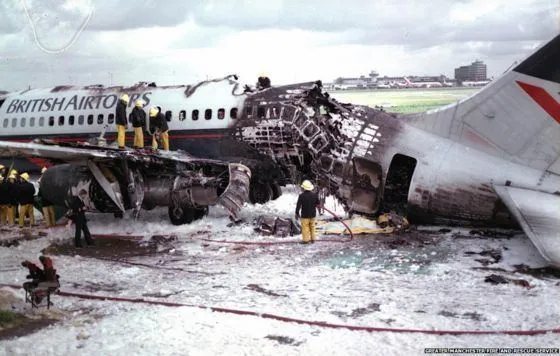 Photo: British Airtours Flight 28M, via alchetron.com
Similar patterns appear in accident after accident: people who survive the initial impact but die because they don't know where the nearest exit is, can't operate their seatbelt under stress, or waste crucial seconds on belongings instead of evacuation.
The Briefing's Hidden Lessons
Viewed through this lens, the safety demonstration isn't preparing you for Hollywood-style disasters — it's teaching behaviors that matter in the chaotic minutes after a survivable crash.
The instruction to "locate your nearest exit, which may be behind you" addresses a documented problem: in emergencies, people instinctively head toward the door they used to board, even when closer exits exist. The reminder to "leave all belongings behind" isn't arbitrary — it's based on investigations showing that luggage retrieval delays have killed people in survivable accidents.
Even the seemingly obvious seatbelt demonstration serves a purpose. Under stress, people forget simple tasks or struggle with mechanisms they use easily under normal conditions. Flight attendants practice emergency commands because they know passengers in real emergencies often freeze or act irrationally.
Why Airlines Don't Emphasize the Survival Angle
If survivable crashes are common and passenger behavior matters, why don't airlines lead with that message? The answer reveals an uncomfortable truth about aviation marketing: emphasizing crash survival might reassure safety-conscious passengers, but it would terrify the much larger group who prefer to believe crashes never happen.
Airlines have spent decades crafting the message that flying is so safe that accidents are essentially impossible. Shifting to "flying is safe, and when accidents do happen, here's how to survive them" would require acknowledging that accidents occur regularly — just not the catastrophic kind that make news.
The result is safety theater that's actually safety training in disguise. The demonstration teaches genuinely useful skills while maintaining the comforting fiction that you'll never need them.
What Flight Crews Actually Know
Flight attendants undergo extensive emergency training not because airlines expect crashes, but because aviation professionals understand the difference between fatal accidents and survivable emergencies. They know that most of their career will be routine, but that the skills they practice could determine whether passengers live or die in the small percentage of flights where things go wrong.
This creates an odd dynamic: the people delivering the safety briefing are trained to save lives in scenarios that passengers assume are unsurvivable. They're teaching real emergency skills to an audience that thinks they're watching regulatory theater.
The Information That Actually Matters
So what should you actually pay attention to during the safety briefing? Aviation safety experts recommend focusing on three things:
First, count the rows between your seat and the nearest exit in both directions. In a smoke-filled cabin, you may need to feel your way to safety. Second, practice the seatbelt release motion — not because it's complicated, but because fine motor skills deteriorate under stress. Third, mentally rehearse leaving everything behind and moving quickly toward exits.
These aren't preparations for movie-style disasters. They're preparations for the kinds of emergencies where your actions in the first few minutes determine whether you're part of the 95.7% who survive or the 4.3% who don't.
The Real Safety Message
The next time you're tempted to ignore the safety demonstration, remember that it's not really about plane crashes as most people imagine them. It's about the much more common scenario where something goes wrong, the plane ends up on the ground in one piece, and everyone has a few minutes to get out safely.
In those situations, the difference between life and death often comes down to whether passengers know what flight attendants have been trying to teach them all along. The safety briefing isn't theater — it's a condensed course in emergency survival, delivered to people who don't realize they're students in a class they might actually need to pass.